Close range aerial perspective, and why height beats focal length
Moving the camera changes the drawing of a building. Changing the lens only changes how much of that drawing you keep. Everything that makes a close range aerial photograph look right, and most of what makes one look wrong, comes out of that single distinction.
Perspective is a function of viewpoint alone. Two photographs taken from exactly the same point with a wide lens and a long lens contain the same relationships between near and far objects; crop the wide frame to match the long one and the two are, geometrically, the same picture. Move the camera thirty feet up and nothing about the scene stays the same: what was hidden behind the parapet appears, the roof acquires depth, the road in front of the entrance stops looking like a wall.
This is why aerial work at close range is a question of where you can put the camera, and why the answer so rarely lies between forty and four hundred feet. Below that band a ladder, a mast or a pole will do. Above it an aircraft is available. In between there is nothing structural, which is exactly the band in which buildings are photographed.
- Perspective
- Set by camera position, never by focal length
- Parallel verticals
- Sensor plane kept parallel to the facade
- Ground sample distance
- Pixel pitch times distance, divided by focal length
- Blur budget
- Keep residual motion under one pixel of the sensor
The half height rule
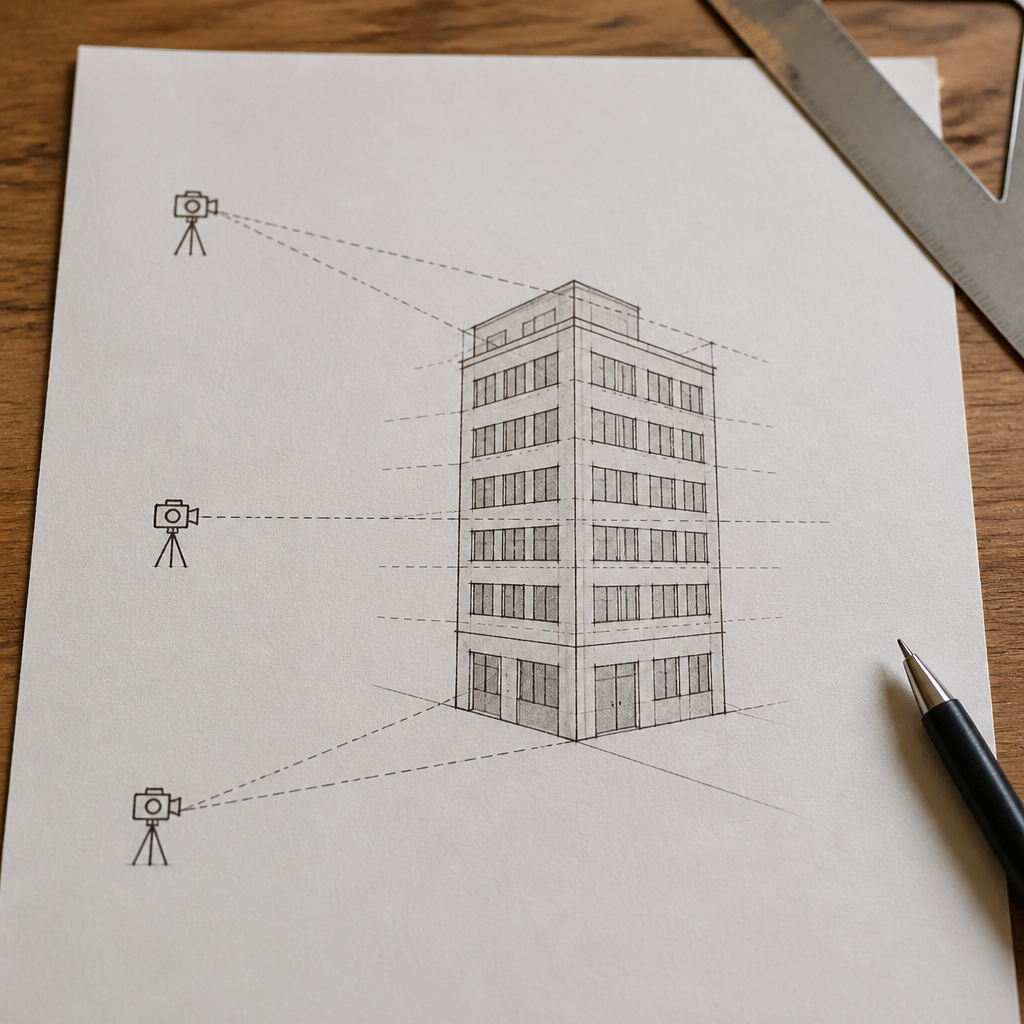
Point a camera upward at a building and its vertical lines converge, because the sensor is no longer parallel to the facade. The building appears to lean back. The cure is not a correction in software, which throws away pixels at the top of the frame; it is to keep the sensor plane vertical and put the camera at half the height of the subject. From there a level camera frames the facade symmetrically, and every vertical edge stays vertical.
Half height explains most requests that reach an aerial operator. A four storey building wants a camera around twenty five feet up, which is a mast. A twelve storey building wants it around seventy feet, which is nothing convenient at all. A forty storey tower wants two hundred feet, and from there the demands become airspace questions rather than optical ones.
How far back you then have to stand is set by the vertical angle of view. For a full frame sensor twenty four millimetres high, a thirty five millimetre lens covers about thirty eight degrees vertically, so a thirty metre building photographed from its half height needs roughly forty four metres of standoff to fit the frame.1 On a tight urban site that standoff does not exist, and the picture has to be made from higher up and further along the street instead.
A leaning building is not a style. It is the signature of a camera that was in the wrong place and tried to make up for it by tilting.
On keystone distortion
How much detail a given height actually gives
Ground sample distance is the size of one pixel measured on the subject, and it is the honest way to talk about resolution. The formula is simple: pixel pitch multiplied by distance, divided by focal length. A twenty four megapixel full frame sensor is thirty six millimetres wide over six thousand pixels, so its pitch is six micrometres.2
| Distance | 35 mm lens | 85 mm lens | What that resolves |
|---|---|---|---|
| 30 m | 5.1 mm | 2.1 mm | Mortar joints, panel gaskets |
| 60 m | 10.3 mm | 4.2 mm | Brick courses, window frames |
| 120 m | 20.6 mm | 8.5 mm | Cladding modules, roof plant |
| 250 m | 42.9 mm | 17.6 mm | Bay rhythm, massing only |
The table settles a common argument. If a client needs to read a defect in a facade, the answer is not a higher platform with a longer lens, because doubling both leaves the ground sample distance unchanged. It is to get closer, or to accept that the picture is for context and the defect needs its own frame.
Field of view, for reference
- 24 mm on full frame: about 74 degrees horizontally, useful for context and for tight sites;
- 35 mm: about 54 degrees, the workhorse for a whole elevation;
- 50 mm: about 40 degrees, close to the drawing a viewer reads as natural;
- 85 mm: about 24 degrees, for detail and for compressing a row of buildings.
The blur budget on a moving platform
A camera hanging under a tethered aerostat is on a pendulum, and a camera on a multirotor is on a machine correcting itself several hundred times a second. Both leave residual angular motion, and the way to reason about it is in pixels rather than in degrees.
One pixel subtends an angle equal to the pixel pitch divided by the focal length. Six micrometres on a fifty millimetre lens is 0.00012 radians, about 0.007 degrees. So a residual pan of one degree per second sweeps roughly one hundred and forty five pixels per second across the sensor.3 At one five hundredth of a second that is a third of a pixel and invisible. At one sixtieth it is two and a half pixels and clearly soft. The rule of thumb writes itself: on a swinging platform, buy shutter speed with aperture and sensitivity before you buy it with anything else.
The corollary is what makes tethered platforms interesting again at dusk. There are no propellers, so once the pod has settled the only motion left is slow pendulum drift, and long exposures become possible in a way they are not on a multirotor. Sessions that need a thirty second frame at blue hour are one of the few remaining cases where a line to the ground beats a battery.
Light behaves differently at eighty feet
Two things change as the camera rises. The horizon opens, so the sky occupies more of the frame and the exposure range widens; a facade that metered comfortably from the street may sit four stops under a bright sky from above. And the angle to the sun changes relative to the surfaces you care about, which matters because a facade reads through raking light. A flat frontal sun at noon flattens texture; a low sun at a shallow angle to the plane brings out every reveal and every joint.
Choosing the height before choosing the platform
The useful sequence is to decide the picture first and the machine last. Fix the subject, fix the drawing you want, and the half height rule gives you an elevation. The standoff follows from the angle of view. The ground sample distance tells you whether the detail the client is talking about is even in the frame. Only then does it matter whether the camera is going up on a mast, a multirotor, a tethered hull or the roof of the building opposite, and that choice is made on access, endurance and airspace rather than on optics.4
Applied to real briefs, that sequence produces four quite different jobs, which is the subject of the page on aerial photography for architecture projects. Applied to a building that does not exist yet, it produces the preconstruction view study, where the elevation is not a choice but a survey figure.
Notes
- Vertical angle of view equals twice the arctangent of half the sensor height divided by the focal length. For 24 mm of sensor height and a 35 mm lens that is about 37.8 degrees; the standoff is half the subject height divided by the tangent of half that angle. Back
- Ground sample distance equals pixel pitch times distance, divided by focal length, with all three in the same units. The figure ignores lens aberrations and diffraction, both of which make real resolution slightly worse. Back
- One degree per second is 0.01745 radians per second; divided by 0.00012 radians per pixel that is about 145 pixels per second. Back
- Regulatory ceilings differ by platform and are covered separately: a moored balloon and a small unmanned aircraft are not governed by the same part of the federal aviation regulations. Back