Moored balloons, kites and drones in United States airspace
A camera on a rope and a camera on propellers are governed by two different parts of the federal aviation regulations, with different ceilings, different paperwork and different geographic restrictions. Reading both explains most of what a tethered crew spends its morning doing.
Everything below describes the shape of two rules as an introduction for readers who have met neither. It is not advice, it is not current by definition, and the only authoritative text is the one published in the Code of Federal Regulations on the day you fly. Anyone planning an actual operation reads the sections themselves and speaks to the nearest air traffic facility.
With that said, the shape is worth knowing, because it explains behaviour that otherwise looks arbitrary. Tethered aerostat crews spend a lot of time on the telephone and looking at airport boundaries. Drone operators spend almost none, and instead spend it on certification and on an automated authorisation system. The reason is that the two regimes were written half a century apart for entirely different hazards.
- Moored balloons and kites
- 14 CFR Part 101, Subpart B
- Small unmanned aircraft
- 14 CFR Part 107
- Balloon ceiling
- 500 feet above the surface
- Drone ceiling
- 400 feet above ground, with a structure allowance
Which balloons and kites are even covered
Part 101 does not care about a party balloon. Subpart B applies to a balloon moored to the surface, or to something on it, that is more than six feet in diameter or has a gas capacity of more than one hundred and fifteen cubic feet, and to any kite weighing more than five pounds that is intended to be flown on a rope or cable.1 Every camera aerostat worth the helium is comfortably inside those thresholds, and so is any kite capable of lifting a camera.
The operating limits, and why the map matters more than the ceiling
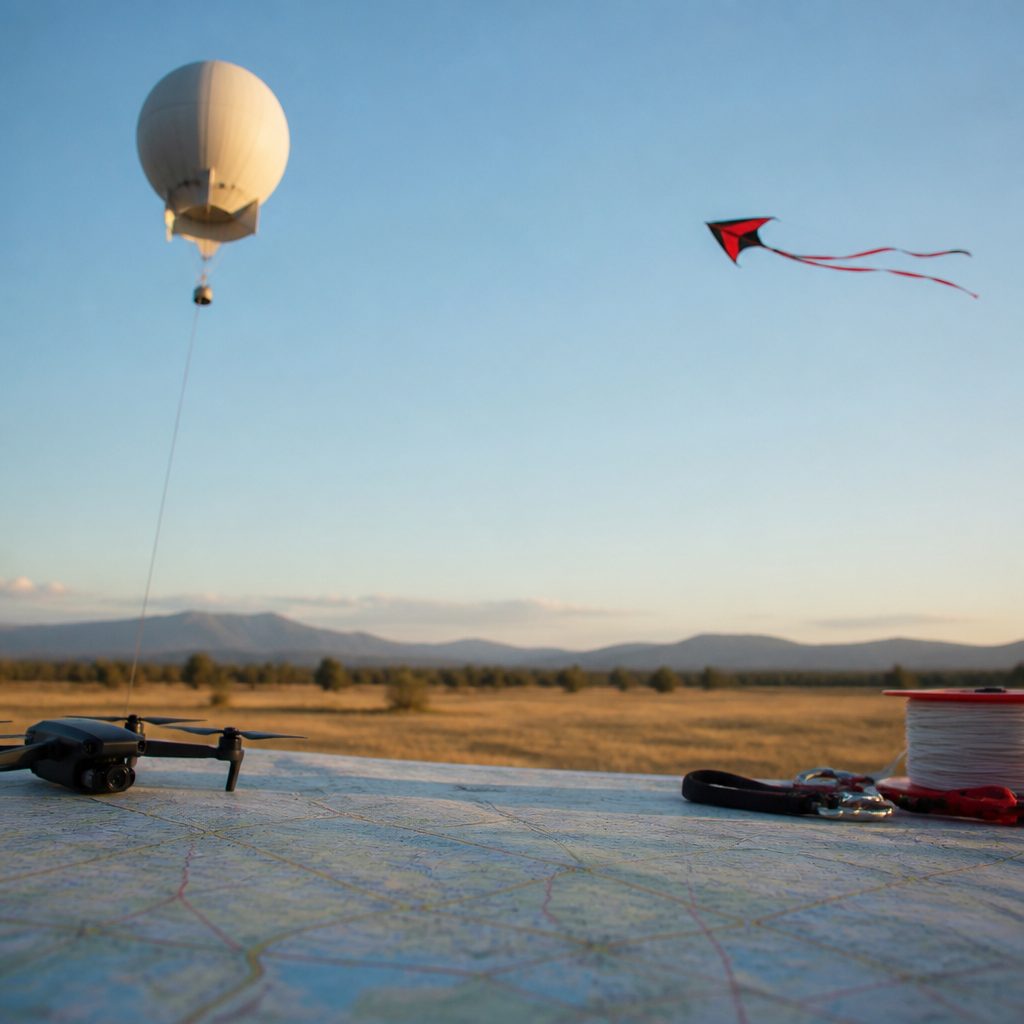
The core limits sit in one short section. A moored balloon or kite may not be operated more than five hundred feet above the surface, nor less than five hundred feet from the base of any cloud, nor where ground visibility is under three miles, nor within five miles of the boundary of any airport.2
The five hundred foot ceiling is generous. The five mile airport radius is what actually decides whether the job exists.
On reading Part 101 in the right order
That last clause is the one that reshapes a business. Five miles from the boundary of any airport, taken literally across a metropolitan area with several fields and a scatter of heliports and private strips, removes a great deal of buildable land from consideration. Deviations exist within the regulatory framework, but they are authorisations to be obtained, not assumptions to be made.
Above one hundred and fifty feet, an unshielded operation also owes notice. The rule requires the operator to give the nearest air traffic control facility, at least twenty four hours before beginning, the name and address of the operator, the size and colour of the balloon, the location of the operation, the height at which it will be flown, and the date, time and duration of the flight.3 That telephone call is the first item on a tethered crew's morning list.
Marking, lighting and the escape device
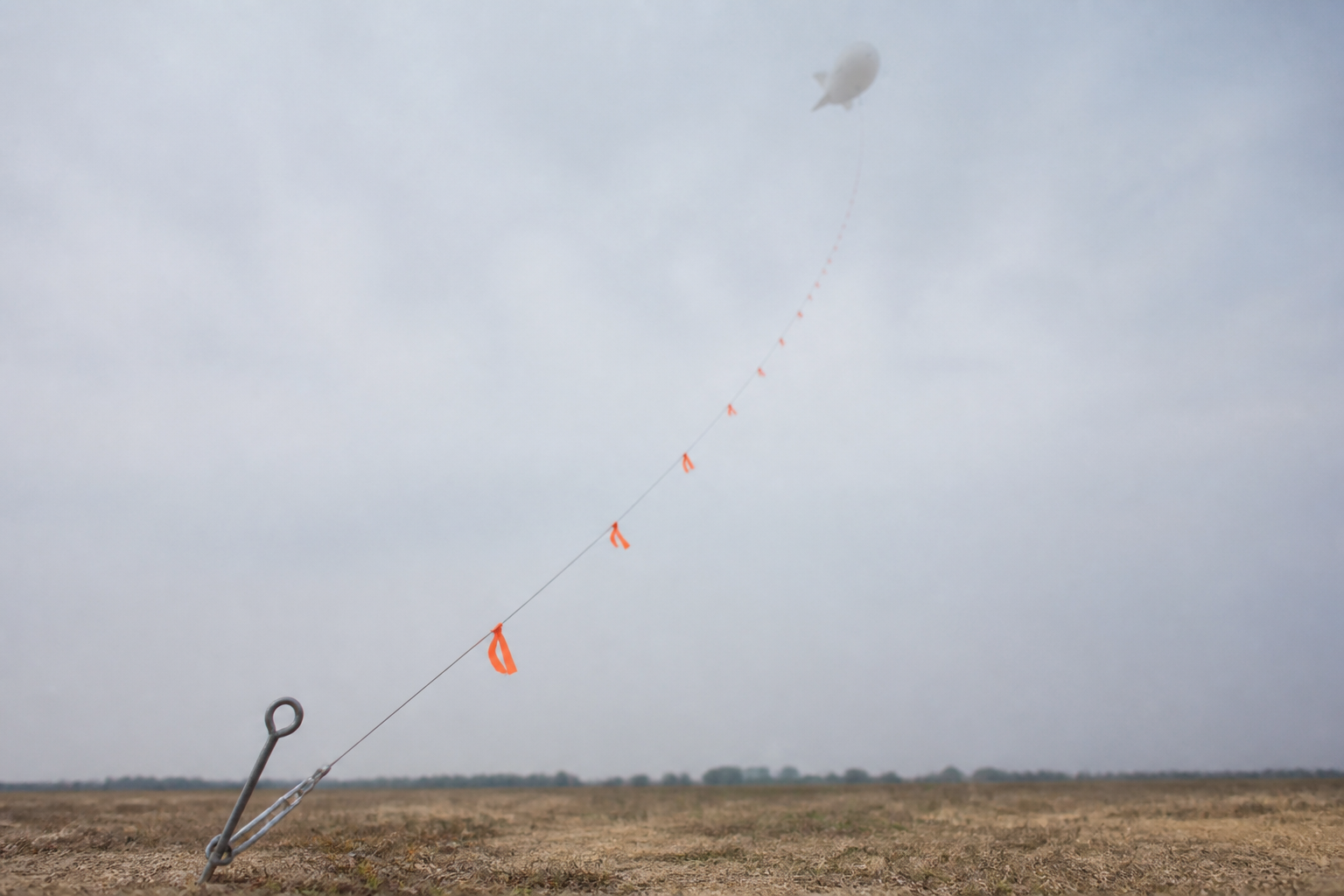
- mooring lines carry coloured pennants or streamers at intervals of no more than fifty feet, beginning one hundred and fifty feet above the surface, visible for at least a mile;
- operations between sunset and sunrise require lighting as prescribed by the rule;
- a moored balloon must carry a device that will automatically and rapidly deflate it if it escapes its moorings, and if the balloon gets away and the device fails, the operator must notify the nearest air traffic control facility immediately.4
Part 107, in outline
The rule that governs commercial small unmanned aircraft in the United States took effect on 29/08/2016 and is a much longer document, because it regulates a machine that can go somewhere.5 Its familiar shape: the aircraft weighs less than fifty five pounds including everything on board; the operator holds a remote pilot certificate; the aircraft stays within visual line of sight; it stays at or below four hundred feet above ground level, or within four hundred feet of a structure and no more than four hundred feet above that structure; groundspeed stays at or below one hundred miles an hour; flight visibility is at least three statute miles from the control station. Controlled airspace requires an authorisation, and remote identification has been required of operators since 16/09/2023. One line in that list presumes hardware rather than paperwork: visual line of sight only holds while the control link does, and what the link's figures promise is a separate piece of arithmetic.
Two clarifications save arguments. A multirotor on a tether is still an unmanned aircraft: a rope does not move it into Part 101. And recreational flying sits under a separate statutory exception rather than under Part 107, which is why the answers a hobbyist gives about the rules are frequently not the answers that apply to commissioned work.
| Question | Moored balloon or kite | Small unmanned aircraft |
|---|---|---|
| Rule | 14 CFR Part 101, Subpart B | 14 CFR Part 107 |
| Certificate | None required by the rule | Remote pilot certificate |
| Ceiling | 500 ft above the surface | 400 ft above ground, structure allowance aside |
| Near airports | Not within five miles of any airport boundary | Authorisation for controlled airspace |
| Advance notice | 24 hours above 150 ft, unshielded | Not generally, authorisation instead |
| Visibility | At least three miles on the ground | At least three statute miles from the control station |
| Marking | Pennants on the line, lighting at night | Anti collision lighting at night, remote identification |
| Escape provision | Automatic rapid deflation device | Not applicable |
How this shapes a working day
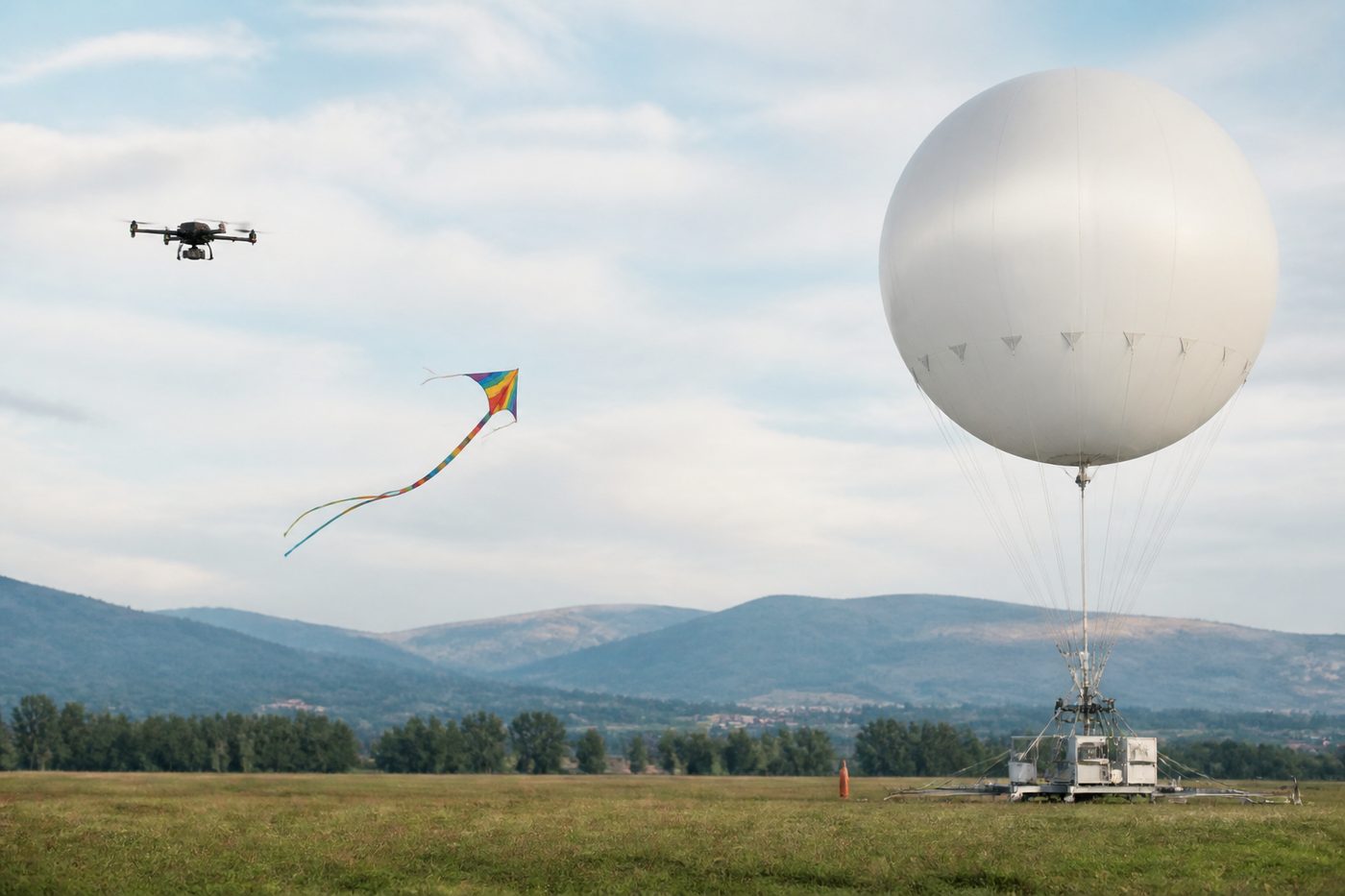
For a tethered crew the sequence is: check the airport map first, because it is the constraint that cannot be worked around; make the notification call the day before; rig the line with pennants during setup rather than in the air; confirm the deflation device before the pod goes on; and keep a written note of the notice given, since the whole point of a notification is that somebody can later confirm it happened. A worked case is the field note on the disk that fills up with frames.
For a drone operator the sequence is almost the inverse: certification and currency are already in place, airspace authorisation is checked and requested electronically, and the day's real work is line of sight management and the area beneath the aircraft. Which of the two suits a given job is the subject of the comparison page, and the physics that limits the tethered option is on the lift and rigging page. The limiting case for all of it is a mass launch: hundreds of balloons in one dawn window is what this planning looks like when the whole field moves at once. This practice is set out in Fuel Transfer Geometry vs Camera Station.
Notes
- Applicability: 14 CFR 101.1. The same part also covers unmanned free balloons and amateur rockets in other subparts, which are not discussed here. Back
- Operating limitations: 14 CFR 101.13. The section also provides for operation otherwise than in accordance with those limits where authorised; the current text is the only reliable statement of the conditions. Back
- Notice requirements: 14 CFR 101.15, which also sets out when notice is not required. Back
- Lighting and marking: 14 CFR 101.17. Rapid deflation device: 14 CFR 101.19. Back
- Part 107 took effect on 29/08/2016. Altitude and speed limits: 14 CFR 107.51. Airspace authorisation: 14 CFR 107.41. Remote identification is a separate part, with operator compliance required from 16/09/2023. Back