Reference
Glossary of low altitude aerial imaging
The words used across this site, defined once so that the articles do not have to stop and explain themselves. Grouped by where they come from: the physics of the platform, the optics of the picture, and the survey and regulatory vocabulary that surrounds both.
Definitions here are short on purpose. Where a term carries a precise regulatory or survey meaning, that meaning is given rather than the loose one, and the page that treats it properly is linked from the entry.
47 terms. Last revised 12/08/2026.
The platform and its physics
- Aerostat
- Any aircraft that stays up by being lighter than the air it displaces, rather than by generating lift from motion. Balloons and airships are aerostats; aeroplanes and multirotors are not.
- Blimp
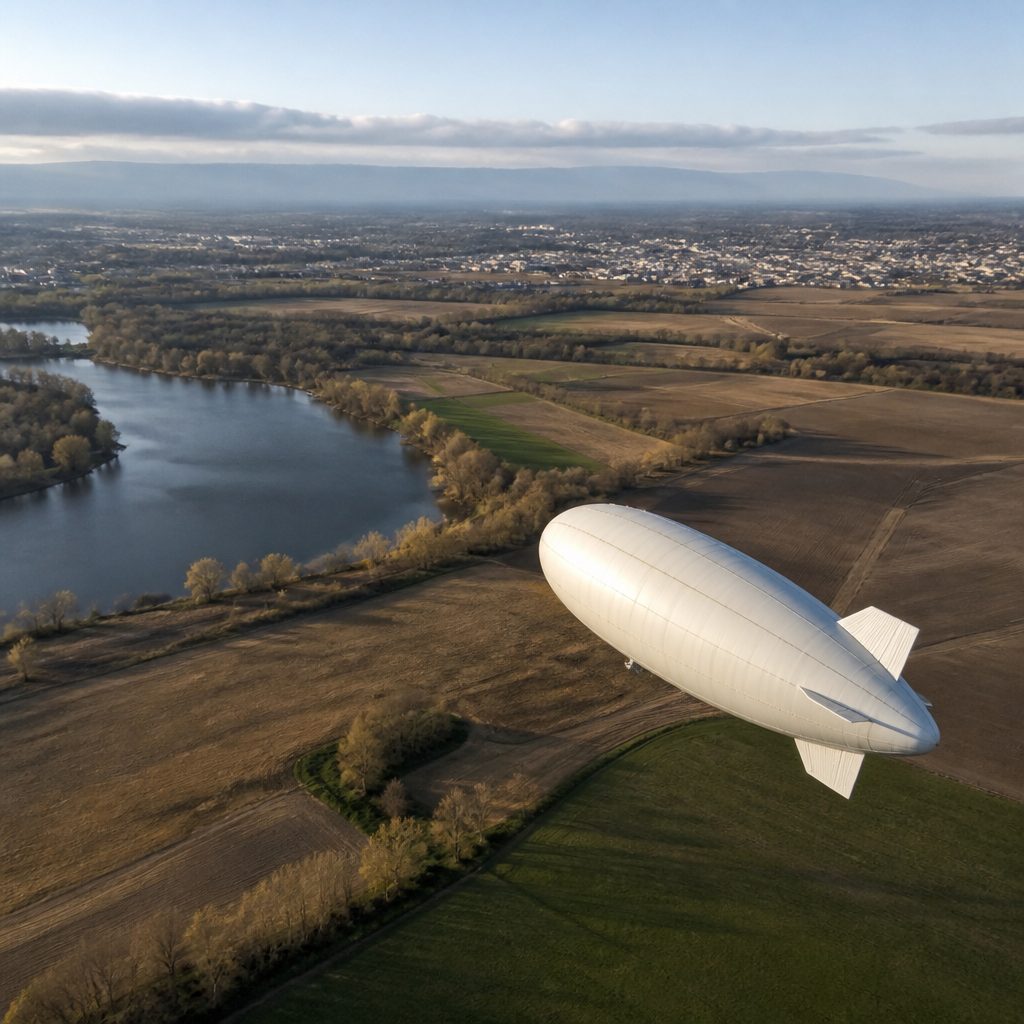
- A non rigid airship. It has no internal frame and holds its shape because the gas inside is at slightly higher pressure than the air outside. Deflate it and nothing remains but fabric.
- Rigid airship
- An airship whose hull shape is carried by an internal structure, with the gas held in separate cells inside it. Distinct from a blimp, and not used for camera work.
- Envelope
- The gas containing hull itself: coated fabric or film, made up of panels joined into a body of revolution, with reinforced patches where loads are attached.
- Gore
- One of the tapering panels that, joined edge to edge, form the curved surface of an envelope. The number of gores is a manufacturing choice, not an aerodynamic one.
- Ballonet
- An air filled compartment inside the envelope. Gas expands as the craft rises and air is pushed out of the ballonet to make room; a fan refills it on descent. It keeps the hull taut across a range of altitudes without venting helium.
- Fineness ratio
- Length divided by maximum diameter. Camera aerostats sit around three or four to one, which is where the drag penalty of extra length stops paying for the drag saved by streamlining.
- Gross lift
- The full lifting force of the gas, equal to the weight of the air displaced minus the weight of the gas. Helium gives about 1.05 kilograms per cubic metre at sea level.
- Net lift
- Gross lift minus the weight of the aerostat itself: envelope, fins, valve and rigging.
- Free lift
- Net lift minus the payload and the carried part of the tether. The upward force actually available to resist wind, and the number a crew sets deliberately with ballast. See lift and rigging.
- Ballast
- Weight added to reduce free lift to the intended figure. Usually water or sand, because it can be shed in known increments.
- Weigh off
- The ground procedure of adding or removing ballast until the platform has the free lift planned for the day. Repeated at the start of every session, never inherited from the last one.
- Superheat
- The condition in which the gas inside an envelope is warmer than the surrounding air, usually from sunlight on the fabric. It expands the gas and briefly increases lift, and it disappears when a cloud passes.
- Purity
- The proportion of helium in the gas actually inside the hull. It falls with every top up, because fresh gas mixes with a volume that already contains air, and lift falls with it.
- Relief valve
- The pressure valve that vents gas as it expands with altitude. It exists so that the valve, rather than the fabric, is what gives way.
- Bridle
- The set of lines that spread the load from the tether or the payload across several attachment points on the hull, instead of concentrating it at one.
- Tether
- The line from the aerostat to the ground. On camera platforms it is typically a braided high modulus polyethylene of two to four millimetres, chosen for strength to weight and low stretch.
- Mooring
- The anchoring of the aerostat to the ground or to an object on it. In United States regulation, a moored balloon is a distinct category with its own rules. See airspace rules.
- Blowdown
- The loss of altitude caused by wind pushing the aerostat downwind and lowering the angle of the tether. Height reached equals line length times the sine of the tether angle, so a forty five degree line keeps only seventy one per cent of its length.
- Weathervaning
- The tendency of a finned hull to turn nose into wind and stay there. It is what fins are for, and what a spherical balloon cannot do.
- Kite balloon
- A tethered balloon shaped and finned so that the wind contributes lift rather than only drag. The military observation balloons of the First World War were of this type, and the modern camera aerostat inherits their silhouette.
- Rapid deflation device
- A mechanism that collapses a moored balloon automatically if it escapes its moorings. United States regulation requires one.
The picture
- Ground sample distance
- The size of one sensor pixel measured on the subject. Pixel pitch times distance, divided by focal length. The honest way to state the resolution of an aerial image. See close range perspective.
- Pixel pitch
- The physical spacing between pixel centres on a sensor. A thirty six millimetre wide sensor with six thousand pixels across has a pitch of six micrometres.
- Angle of view
- The angular extent of the scene a lens and sensor combination records. Twice the arctangent of half the sensor dimension divided by the focal length.
- Keystone distortion
- The convergence of vertical lines that appears when a camera is tilted up at a building. It is a symptom of camera position, and correcting it in software costs pixels.
- Perspective control
- Keeping the sensor plane parallel to the subject plane so that parallel lines stay parallel, by shifting the lens or by placing the camera at half the subject height.
- Nadir
- The direction straight down from the camera. A nadir image looks vertically at the ground and is the basis of mapping photography.
- Oblique
- Any image taken at an angle between nadir and the horizon. Most architectural aerial photographs are obliques.
- Photogrammetry
- The measurement of objects from photographs, by triangulating features that appear in overlapping images taken from different positions.
- Orthomosaic
- A composite image in which perspective has been removed so that every pixel sits at a single scale, allowing distances and areas to be measured off it directly.
- Ground control point
- A marked point on the ground whose coordinates are known by survey, used to tie a photogrammetric model to real world position and scale. Accuracy depends on these, not on the camera.
- Remote head
- The motorised pan and tilt mount that carries the camera under the platform, driven from the ground. Roll is usually handled by the bridle rather than by a motor.
- Civil twilight
- The period when the sun is between the horizon and six degrees below it. The short window in which artificial light inside a building and remaining daylight outside it balance.
- Fixed station photography
- Photographing a subject repeatedly from an identical position with an identical lens, so that successive images can be compared as a measurement of change rather than viewed as separate pictures. See progress records.
Site, survey and airspace
- Viewshed
- The set of all locations visible from a given observation point, computed by tracing lines of sight across an elevation model. A computed surface, not a description of scenery. See viewshed and cost.
- View corridor
- A sightline protected by zoning, usually by capping building heights inside a mapped wedge of land. A legal object, not a geometric one.
- Observer offset
- The height added above the model surface at the observation point in a viewshed calculation.
- Digital surface model
- An elevation model that includes everything the sensor saw: ground, buildings and vegetation. The right input for a viewshed in a built up area.
- Digital terrain model
- An elevation model of bare earth, with buildings and vegetation removed. A viewshed computed on one will see straight through a city.
- Finished floor elevation
- The height of a completed floor surface above a stated vertical datum. The reference a preconstruction view study must be tied to. See view studies.
- Vertical datum
- The agreed reference surface from which heights are measured. A height quoted without naming its datum is an incomplete figure.
- Moored balloon
- In United States regulation, a balloon tethered to the surface or to an object on it, above stated size thresholds. Governed by Part 101 of the federal aviation regulations, with a ceiling of five hundred feet above the surface.
- Small unmanned aircraft
- An unmanned aircraft weighing less than fifty five pounds including everything on board. Commercial operation in the United States is governed by Part 107. A tether does not change the category.
- Visual line of sight
- The requirement that the remote pilot, or a designated observer, keeps the aircraft in unaided sight throughout the flight.
- Kite aerial photography
- Lifting a camera on a kite line, usually with the rig suspended below the kite on a Picavet or pendulum suspension. Cheap, licence free in most settings, and still used in archaeology.
- Pole aerial photography
- A camera on a telescopic mast, operated from the ground. Reaches twenty to sixty feet, needs no airspace permission, and answers a surprising share of briefs that arrive asking for aerial work.
Where these terms are used
-
Lift, drag and the tether
Gross lift, net lift, free lift, ballast, superheat, purity and blowdown, worked through with the arithmetic and two tables.
-
Close range aerial perspective
Ground sample distance, pixel pitch, angle of view, keystone distortion and the blur budget on a moving platform.
-
Viewshed and cost drivers
Observer offset, surface models, view corridors, horizon distance and the eight variables that multiply an aerial job.
-
Moored balloons, kites and drones
Where the regulatory definitions above come from, and what each regime asks of a crew.