Lift, drag and the tether: the arithmetic of holding a camera up
One cubic metre of helium lifts about one kilogram at sea level. Every other figure on a tethered platform, including how much of your rope the wind is going to eat, follows from that number and from two pieces of school geometry.
Archimedes settles the whole question. A body immersed in a fluid is pushed up by a force equal to the weight of the fluid it displaces. An envelope full of helium displaces its own volume of air, so the lift it generates is the weight of that air minus the weight of the gas inside. At the sea level reference conditions of the International Standard Atmosphere, dry air weighs 1.225 kilograms per cubic metre and helium weighs 0.1786, which leaves 1.046 kilograms of lift per cubic metre.1 Round it to 1.05, or to 0.065 pounds per cubic foot, and you have the constant the rest of this page uses.
Hydrogen does better: at 0.0899 kilograms per cubic metre it gives about 1.135 kilograms of lift per cubic metre, roughly eight per cent more than helium.2 Eight per cent is not enough to justify a flammable gas on a line above an occupied site, which is why every camera aerostat you will meet is filled with helium.
- Net lift of helium
- 1.05 kg per cubic metre, 0.065 lb per cubic foot
- Scaling
- Lift follows the cube of the diameter, drag the square
- Height from a tether
- Line length times the sine of the tether angle
- Load from wind
- Proportional to the square of wind speed
Why small envelopes are hopeless and large ones are awkward
Volume grows with the cube of a linear dimension. Double the diameter of a spherical balloon and you multiply its lift by eight, while its surface area, and therefore roughly its fabric weight, only goes up by four. This is why toy sized envelopes carry nothing useful and why the first serious step up in payload comes with a surprisingly large hull.
| Diameter | Volume | Gross lift | In pounds |
|---|---|---|---|
| 2 m | 4.2 cubic metres | 4.4 kg | 9.7 lb |
| 3 m | 14.1 cubic metres | 14.8 kg | 32.6 lb |
| 4 m | 33.5 cubic metres | 35.0 kg | 77.3 lb |
| 5 m | 65.4 cubic metres | 68.5 kg | 151 lb |
Read the table the other way round and it explains the shape of the industry. A camera and a remote head weighing four kilograms, plus a hull, plus rigging, plus tether, is comfortably inside a four metre envelope and marginal in a three metre one. Below that you are choosing between a compact camera and no free lift at all.
Three words that are not synonyms
- Gross lift is what the displaced air gives you, the figure in the table above.
- Net lift is gross lift minus the weight of the aerostat itself: envelope, fins, valve, patches, rigging.
- Free lift is net lift minus the payload and the carried part of the tether. It is the upward force actually available to fight the wind, and it is the number a crew sets deliberately by adding or removing ballast before launch.
Shape is not styling
A sphere is the cheapest way to enclose a volume and the worst way to fly it. The force the wind applies is one half of the air density, times wind speed squared, times a drag coefficient, times a reference area.3 Only the speed term varies during a session and it is squared, so a wind rising from six to twelve knots roughly quadruples the load on the line. A streamlined body of revolution with a fineness ratio around three or four to one, which is the classic blimp silhouette, cuts the coefficient several times over compared with a sphere of the same volume.
Fins are not decoration. Without them the hull hunts from side to side, and the camera under it does the same.
Why camera aerostats look like small airships
The fins at the stern do the second half of the job. They put the aerodynamic centre behind the point where the tether pulls, which makes the hull weathervane: it turns nose into wind and stays there. A sphere has no preferred heading, so it wanders, and the pod beneath it wanders with a delay, which is precisely the motion that ruins a long exposure.
Larger aerostats add a ballonet, an air filled compartment inside the envelope. As the craft climbs, the helium expands; air is pushed out of the ballonet to make room, and on descent a fan refills it. The hull therefore stays taut and keeps its shape across a range of altitudes without venting gas. Small camera hulls often skip the ballonet and accept a narrower altitude band instead.
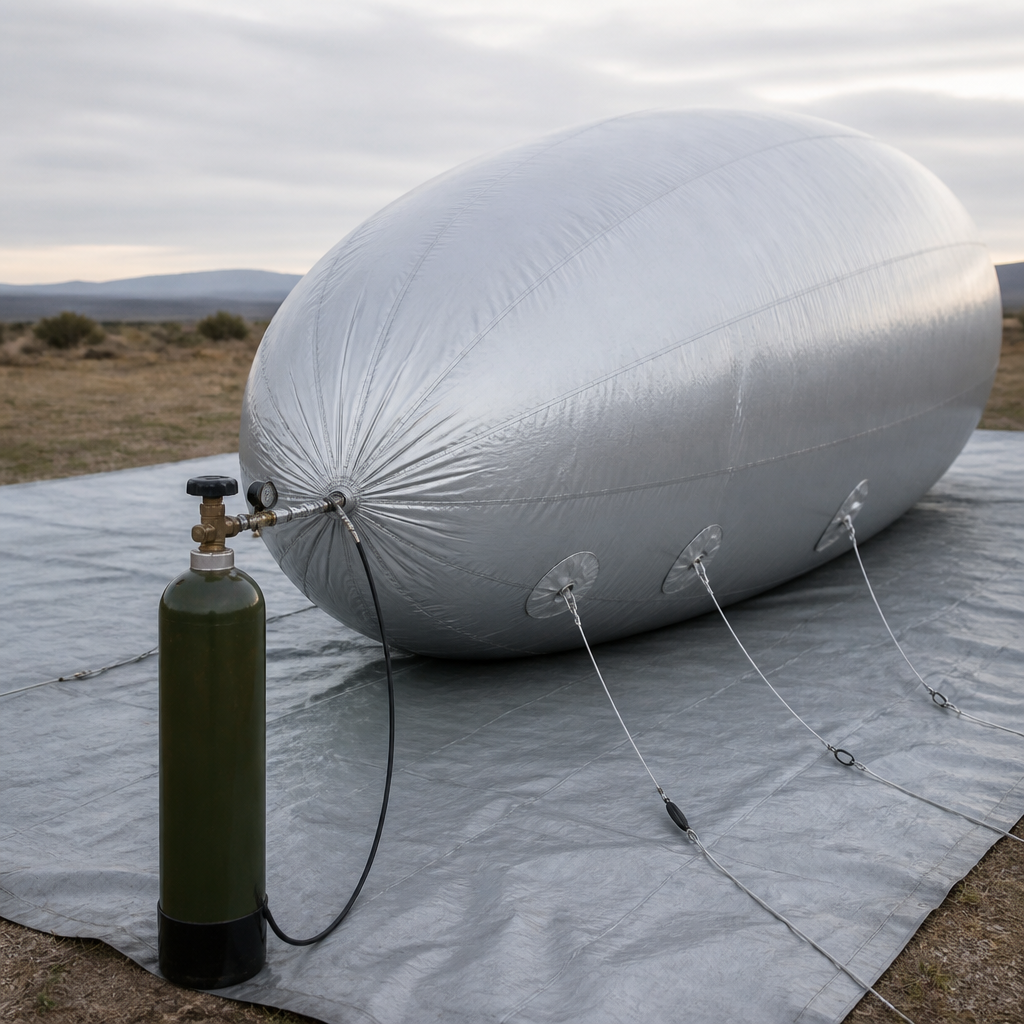
Blowdown: the geometry that costs you altitude
Assume for a moment that the tether is a straight line. The height reached is then the length paid out multiplied by the sine of the angle the line makes with the ground, and that angle is set by the balance between free lift pulling up and drag pushing back. The consequences are blunt.
| Tether angle | Height retained | Height from 300 ft | Downwind offset |
|---|---|---|---|
| 75 degrees | 97 per cent | 290 ft | 78 ft |
| 60 degrees | 87 per cent | 260 ft | 150 ft |
| 45 degrees | 71 per cent | 212 ft | 212 ft |
| 30 degrees | 50 per cent | 150 ft | 260 ft |
The fourth column is the part crews under estimate. At forty five degrees the platform is as far downwind as it is high, so a shoot planned from a fixed anchor point ends up looking at the subject from somewhere else entirely. On a constrained site the downwind offset, not the altitude, is what ends the session.
Real tethers sag, so the straight line assumption is optimistic. The line hangs in a curve whose shape depends on its weight per metre and the tension in it, and the achieved height is always a little less than the sine calculation suggests. Heavier line sags more, which is one argument for the thinnest cordage that still carries the load with a proper safety factor.
Gas management, which is really cost management
Helium leaks. It is the second smallest molecule there is and it works its way through polymer film continuously, so a hull loses lift day after day even when it is sitting in a hangar. Repeated topping up dilutes what is left, because each refill mixes fresh gas with a volume that already contains air, and lift falls with purity. A platform that has been topped up five times is not carrying what it carried when new.
Temperature works both ways. Lift is proportional to the density of the surrounding air, so a hot afternoon reduces it. Against that, sunlight heats the gas above ambient, a condition called superheat, which expands it and briefly increases lift; the same envelope can behave differently at eleven in the morning and at four in the afternoon on one cloudless day.
The line, and the rules attached to it
Camera tethers are usually a braided high modulus polyethylene of two to four millimetres, chosen because it is light for its strength and does not stretch much. At that diameter the line weighs on the order of five grams per metre, so three hundred feet of it is roughly half a kilogram that has to come out of the lift budget. Breaking strength is not the binding constraint; abrasion where the line crosses an edge is, which is why crews fair the line over anything it touches.
Federal regulation treats that line as part of the aircraft. Mooring lines must carry coloured pennants or streamers at intervals of no more than fifty feet, beginning one hundred and fifty feet above the surface, and a moored balloon must carry a device that deflates it automatically and rapidly if it ever gets away.5 The full picture, including the notice a crew owes to air traffic control and the ceiling that applies, is set out in the page on moored balloon and drone rules.
Put the three constraints together, lift budget, blowdown geometry and gas cost, and the operating envelope of a tethered camera platform draws itself: light wind, a site with room downwind, a payload chosen before the hull rather than after, and a working day that starts with a weigh off. What that envelope is good for, and what a multirotor does better, is the subject of the comparison page.
Notes
- International Standard Atmosphere, sea level: 15 degrees Celsius, 1013.25 hectopascals, dry air density 1.225 kg per cubic metre. Helium at the same conditions is 0.1786 kg per cubic metre. Back
- Hydrogen at the same reference conditions is 0.0899 kg per cubic metre, giving 1.135 kg of lift per cubic metre against 1.046 for helium. Back
- Drag equation: force equals one half times air density times velocity squared times drag coefficient times reference area. For bodies of revolution the reference area is often taken as volume to the power two thirds rather than frontal area. Back
- Helium Stewardship Act of 2013. The reserve, held in a geological formation near Amarillo in Texas, had supplied a large share of world demand for decades. Back
- Marking of mooring lines: 14 CFR 101.17. Rapid deflation device: 14 CFR 101.19. Back